Pole Anatomy 101: What’s on a Pole?
Ever looked at a utility pole and wondered what all those wires, boxes, and contraptions are? You’re not alone! These towering structures are essential for our modern world, delivering electricity, internet, and communication signals right to our homes and businesses. But there’s a lot more to them than meets the eye.
In this “Pole Anatomy 101,” we’ll break down the key components you might find on a typical utility pole. Understanding these elements can give you a new appreciation for the infrastructure that powers our daily lives.
The Pole Itself: More Than Just a Stick
While we often just call them “poles,” these structures are carefully engineered to withstand the elements and support significant weight. They’re typically made of treated wood, concrete, or steel.
- Wood Poles: The most common type, usually made from pine or cedar, treated to prevent rot and insect damage. They’re cost-effective and relatively easy to install.
- Concrete Poles: Offer greater durability and resistance to rot and fire, often used in areas prone to severe weather or where a longer lifespan is desired.
- Steel Poles: Strong and slender, these are frequently used in urban areas where space is limited, or for high-voltage transmission lines.
The Wires: Your Lifeline to Power and Connectivity
The most prominent features on any pole are, of course, the wires. But not all wires are created equal! They serve different purposes and carry varying levels of voltage.
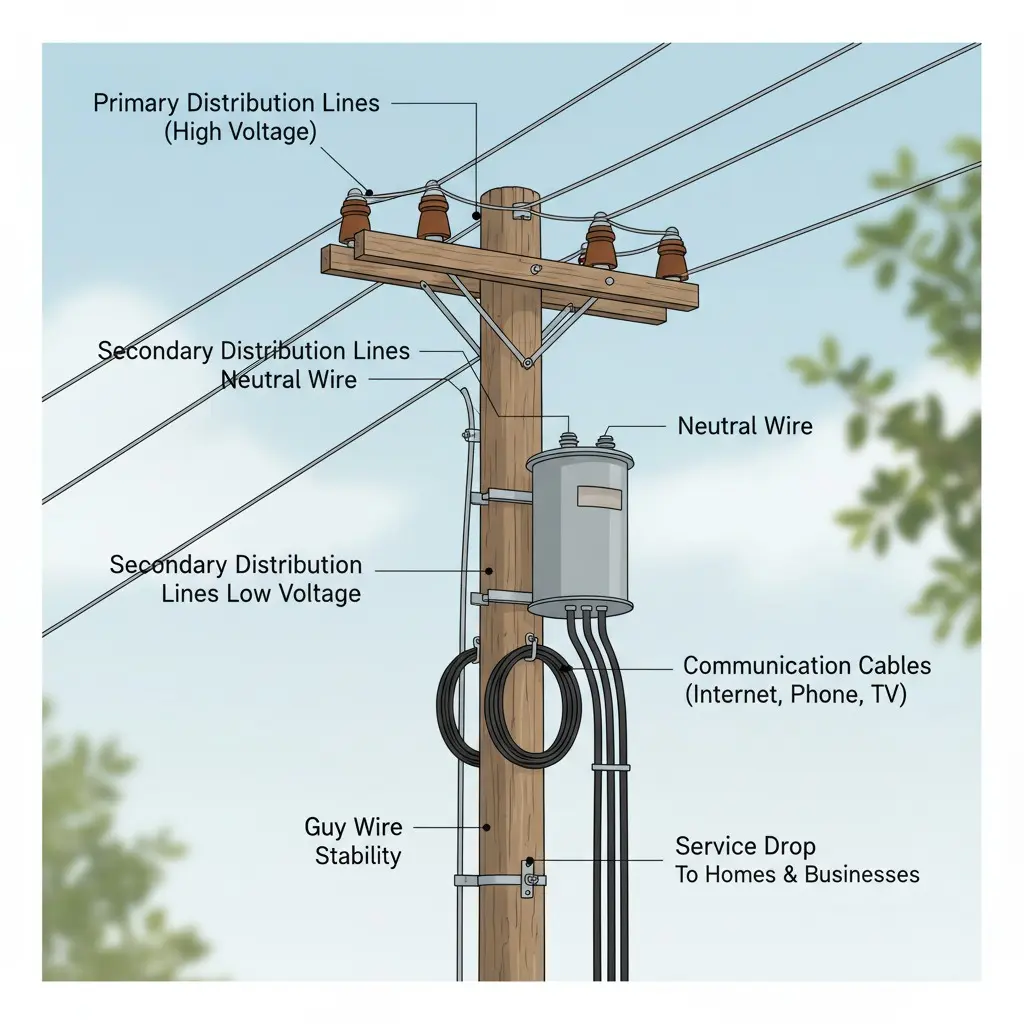
- Primary Distribution Lines (High Voltage): These are the uppermost wires on a pole and carry higher voltage electricity from substations to neighborhoods. They are uninsulated and very dangerous.
- Secondary Distribution Lines (Low Voltage): Located below the primary lines, these wires carry lower voltage electricity that’s safe for use in homes and businesses. They often appear as bundled cables.
- Neutral Wire: This wire works in conjunction with the primary and secondary lines to complete the electrical circuit and provide a safe return path for electricity.
- Communication Cables (Lower Down): Below the power lines, you’ll find cables for internet, telephone, and cable TV. These are typically insulated and much safer to be around, though still best left to professionals.
The Hardware: Holding Everything Together
Poles are equipped with a variety of hardware to secure wires, protect equipment, and ensure safe operation.
- Crossarms: These horizontal beams, usually made of wood or fiberglass, are bolted to the pole and support the power lines. They help maintain proper spacing between wires.
- Insulators: Made of ceramic or glass, these vital components prevent electricity from flowing from the wires into the pole itself. They come in various shapes and sizes depending on the voltage they handle.
- Guy Wires/Strands: These strong, tensioned wires extend from the pole to the ground (or another anchor point) to provide stability and prevent the pole from leaning or falling, especially at corners or where there’s a change in direction for the power lines.
- Brackets and Clamps: A myriad of metal brackets and clamps are used to attach various pieces of equipment, hold wires securely, and manage cable routing.
The Boxes and Equipment: The Brains Behind the Power
Beyond the wires, you’ll often spot various boxes and cylindrical devices. These perform crucial functions in distributing and managing electricity.
- Transformers: These cylindrical or rectangular boxes are probably the most recognizable pieces of equipment. They “step down” the high voltage from primary lines to the lower voltage used in homes and businesses.